I mentioned in a previous post about my reading books about gardening and related subjects. In my side bar, I've listed those that I have read. The list will grow, as I am reading about three right now, in different parts of the house. (I mentioned books could be an issue, didn't I?)
Right now, I'm reading "Gardening when it counts" by Steve Solomon. A very good and thorough book. If you want a lot of semi-technical knowledge, this will be a good read.
Chapter 7 is all about Compost. I never knew there was so much to be concerned aobut. I thought you just take the "brown" and "green" layer them with some dirt and manure and water and BAM! you have compost.
That's what I've done.
But he goes on to talk about what nutrients will be brought to your soil with the compost you make. If you just use what you have available, it's okay, but to make better compost, you have to put more thought into what you put into your compost pile. Which does make sense.
If you only have marginal vegetation to add, you will be putting marginal nutrients into your pile. Kind of like the saying, "Garbage in, garbage out."
Never thought of that in regards to a compost pile.
I am not a scientific person, by any stretch. So some of the things he talks about, I really don't understand, but what I do understand is that perhaps I need to add some things to my compost pile so that I, or rather, my soil, get the most out of the making of the pile.
Do you have any thoughts to share about this?
Showing posts with label reading. Show all posts
Showing posts with label reading. Show all posts
Friday, February 28, 2014

Wednesday, February 26, 2014
I am a Vegetableatarian
Isn't that a cool word?
It's made up by Steve Solomon, from his book "Gardening when it counts".
He says that as he speaks to people, they ask him if he is a vegetarian and he tells them, "no, I am a vegetableatarian."
I'd like to think of myself as a vegetableatarian. I am learning how to eat more of a varied diet for my health and to do that I need to try more vegetables and so, I have to learn how to GROW more vegetables.
I know they say when you start your garden to grow the things you love to eat, which, I did last year. But this year I am going to grow some things I've never grown before and have never eaten before. That excites me.
(again, let me apologize for the pictures. I am trying.)


It's made up by Steve Solomon, from his book "Gardening when it counts".
He says that as he speaks to people, they ask him if he is a vegetarian and he tells them, "no, I am a vegetableatarian."
I'd like to think of myself as a vegetableatarian. I am learning how to eat more of a varied diet for my health and to do that I need to try more vegetables and so, I have to learn how to GROW more vegetables.
I know they say when you start your garden to grow the things you love to eat, which, I did last year. But this year I am going to grow some things I've never grown before and have never eaten before. That excites me.
(again, let me apologize for the pictures. I am trying.)
Mache - Corn Salad - This one I want to try because I've heard so many good things about and that it is also a good one to grow during the winter months.
Nasturtium - I knew that you could eat flowers, but I didn't know about these and that you could eat the leaves as well.
Radish - French Breakfast - Now, we've both eaten radishes before. You know, those small red and white ones that come in a bag in the grocery store, that are usually HOT. Neither of us liked them as a kid and besides the stray one in a salad in a restaurant, I don't think we've eaten them on purpose. But I heard that these French Breakfast radishes are not as HOT and that they grow well in the spring and fall.
Golden Purslane - Yes, it's a weed. I wanted to grow this one for a friend who told me about them, but then when I got the package, it says it contains healthy Omega-3 fats and it's rich in antioxidants.
Herb Dandelion - Yes, another weed! You use the young leaves in salads, and the older leaves as boiled greens. The roots can be roasted and used like coffee. This one I will need to be careful with. It is a perennial.
Carrots - Amarillo - Yes, we've eaten carrots before, but never yellow carrots. They are supposed to be very sweet.
Now, can you see why I am excited to be a Vegetableatarian?
Monday, February 24, 2014
I never thought about this
I'm currently reading, "Gardening when it counts - growing food in hard times" by Steve Solomon.
I read this from the book and thought I would share it, as I had never thought about this before, even before my gardening journey began.
He was talking about how if you live in a place where the ground does not freeze solid to 18 inches or more for a few months, that it may not be possible to grow a garden successfully after the first few years. That you could still grow a garden there. He wasn't saying that a garden wouldn't actually grow. He meant that without crop rotation and the addition of compost that the productivity of the garden would go down.
This is something that I had never thought about.
I know that in the winter it is good to have snow, as it melts slowly into the earth soil it adds needed moisture and nitrogen (I believe, I'll have to look that one up.)
I also know, that in winter, when it's cold, usually germs are killed off by the cold. At least that is what we've always been lead to believe.
So this thought about the freezing ground makes sense to me. It helps to "kill off" the "bad" microorganisms and it gives the "good" ones a starting chance to make the soil good.
It's strange, isn't it? I don't know about you, but now, as I drive around doing my errands or helping someone with theirs, I look at all the yards. All the yards around where I live that are so manicured and well taken care of. Not that there is anything wrong with that. For the people who live there. But I've begun to look at all those homes and say within my head, "wouldn't some apple trees look lovely there?" or "That yard gets so much southern exposure, a vegetable garden would get fabulous light there." And even, "What a nice level yard. I wish I had that one for my garden."
But, as the title of my blog says, "growing where I am planted", the yard I have is the yard I have and I need to make the best of it, sloping ground and all.
So, I continue to read. I continue to learn and listen to what other gardeners thoughts are about growing things, especially soil, as ours was neglected for so long.
It is a journey I am on now and I'd love to have you share it with me. I always love to hear your comments and I hope that you enjoy some tidbit that I care to share.

I read this from the book and thought I would share it, as I had never thought about this before, even before my gardening journey began.
Winter's freezing halts the soil's biological process. When the thaw comes, the soil ecology starts up again, but from near zero. From this cold start, useful soil microorganisms and small soil animals have as good a chance to dominate as do the unwanted ones. The good guys can be helped out with crop rotation and a bit of compost.
He was talking about how if you live in a place where the ground does not freeze solid to 18 inches or more for a few months, that it may not be possible to grow a garden successfully after the first few years. That you could still grow a garden there. He wasn't saying that a garden wouldn't actually grow. He meant that without crop rotation and the addition of compost that the productivity of the garden would go down.
This is something that I had never thought about.
I know that in the winter it is good to have snow, as it melts slowly into the earth soil it adds needed moisture and nitrogen (I believe, I'll have to look that one up.)
I also know, that in winter, when it's cold, usually germs are killed off by the cold. At least that is what we've always been lead to believe.
So this thought about the freezing ground makes sense to me. It helps to "kill off" the "bad" microorganisms and it gives the "good" ones a starting chance to make the soil good.
It's strange, isn't it? I don't know about you, but now, as I drive around doing my errands or helping someone with theirs, I look at all the yards. All the yards around where I live that are so manicured and well taken care of. Not that there is anything wrong with that. For the people who live there. But I've begun to look at all those homes and say within my head, "wouldn't some apple trees look lovely there?" or "That yard gets so much southern exposure, a vegetable garden would get fabulous light there." And even, "What a nice level yard. I wish I had that one for my garden."
But, as the title of my blog says, "growing where I am planted", the yard I have is the yard I have and I need to make the best of it, sloping ground and all.
So, I continue to read. I continue to learn and listen to what other gardeners thoughts are about growing things, especially soil, as ours was neglected for so long.
It is a journey I am on now and I'd love to have you share it with me. I always love to hear your comments and I hope that you enjoy some tidbit that I care to share.
Monday, February 17, 2014
A book called "The Mini Farming Guide to Vegetable Gardening"
It is written by Brett L. Markham and I got it through inter library loan through my local library.
(I have no affiliation with Brett or with Skyhorse publishing.)
I have only read a few pages of this book and I am already liking it. I hope no one minds if I share a paragraph or two that have "hit" me.
"When you grow your own vegetables, you can grow them far less expensively than they can be purchased, thereby making it much more feasible to follow our mother's advice.
Another reason why people don't eat enough vegetables, I am sad to say, is because most vegetables you can buy at the supermarket are unappetizing. Humans have a natural evolutionary desire to consume the most calorie-dense food available in order to avoid starvation. To a degree, this can explain our preference for snake cakes over rutabagas. But another important ingredient in that equation is that industrial agriculture has turned what should be a culinary delight into something so tasteless and useless that it can't be consumed in quantity without a dip or sauce to disguise its bland character."
This is so true.
Growing up, my mother only had a few recipes that were served over and over and over again. We hardly ever tried anything new.
Now, there were always more than one kind of vegetable on the table at any meal, but my mom cooked them to DEATH!! I am sure I mentioned it before, that I didn't know broccoli or asparagus were supposed to be green and not khaki colored and that they were supposed to have a "bite" to them and not be mushy.
No wonder I was never very adventurous with trying different vegetables.
I know, we all tend to blame our mother's for everything. And while I'm not actually blaming my mother, it was growing up with my mother in the kitchen that formed my preferences into adulthood about vegetables.
Once we had our Darling Boy, I tried to include as many choices as I could, but now, being the "mother", I know that I didn't expose him to as many choices as I could have. BUT, I always encouraged him to try new things, no matter where he was or whom he was with. And, I'm glad to say that he always did and have a very well rounded list of items that he eats and prepares himself.
I think part of why I have gotten the gardening bug so badly is that I do want good, nutritious food. I want to know where my food came from, how it was grown and how fresh it is. There is no reason why everyone can't grow something in their yard, and if not in their yard, in containers on their deck. It really isn't that hard or expensive, and it does not take that much time. Everyone of us could make such a statement if we grew some of our own food, even if it were just tomatoes and lettuce through the summer.
So many people spend thousands of dollars on landscaping their yards, and having a lawn service, just imagine if they instead spent one tenth of that on growing some of their own salad items?
I know, I'm not saying anything new, I'm just repeating what so many other's have said, I just felt like I needed to say it and share it.
Thank you for listening.
(I have no affiliation with Brett or with Skyhorse publishing.)
I have only read a few pages of this book and I am already liking it. I hope no one minds if I share a paragraph or two that have "hit" me.
"When you grow your own vegetables, you can grow them far less expensively than they can be purchased, thereby making it much more feasible to follow our mother's advice.
Another reason why people don't eat enough vegetables, I am sad to say, is because most vegetables you can buy at the supermarket are unappetizing. Humans have a natural evolutionary desire to consume the most calorie-dense food available in order to avoid starvation. To a degree, this can explain our preference for snake cakes over rutabagas. But another important ingredient in that equation is that industrial agriculture has turned what should be a culinary delight into something so tasteless and useless that it can't be consumed in quantity without a dip or sauce to disguise its bland character."
This is so true.
Growing up, my mother only had a few recipes that were served over and over and over again. We hardly ever tried anything new.
Now, there were always more than one kind of vegetable on the table at any meal, but my mom cooked them to DEATH!! I am sure I mentioned it before, that I didn't know broccoli or asparagus were supposed to be green and not khaki colored and that they were supposed to have a "bite" to them and not be mushy.
No wonder I was never very adventurous with trying different vegetables.
I know, we all tend to blame our mother's for everything. And while I'm not actually blaming my mother, it was growing up with my mother in the kitchen that formed my preferences into adulthood about vegetables.
Once we had our Darling Boy, I tried to include as many choices as I could, but now, being the "mother", I know that I didn't expose him to as many choices as I could have. BUT, I always encouraged him to try new things, no matter where he was or whom he was with. And, I'm glad to say that he always did and have a very well rounded list of items that he eats and prepares himself.
I think part of why I have gotten the gardening bug so badly is that I do want good, nutritious food. I want to know where my food came from, how it was grown and how fresh it is. There is no reason why everyone can't grow something in their yard, and if not in their yard, in containers on their deck. It really isn't that hard or expensive, and it does not take that much time. Everyone of us could make such a statement if we grew some of our own food, even if it were just tomatoes and lettuce through the summer.
So many people spend thousands of dollars on landscaping their yards, and having a lawn service, just imagine if they instead spent one tenth of that on growing some of their own salad items?
I know, I'm not saying anything new, I'm just repeating what so many other's have said, I just felt like I needed to say it and share it.
Thank you for listening.
Monday, February 10, 2014
Organic Gardening - The book (s)
Since beginning my gardening experience last year, I have purchased a few books and have read ALOT of books that I borrowed from the local public library.
My father got me a subscription to "Organic Gardening" magazine, which I thoroughly enjoy and recommend to any new gardener. (no, I have no affiliation with them.)
As I have mentioned before, books are a downfall for me, and if I am not careful, they become a problem, so I now try to choose very wisely when I buy them.
I bought this book and enjoyed it greatly. I read it from cover to cover, over the course of several weeks and learned a great many things, and relearned some things that I had forgotten.

This is an old one, written by Samuel Ogden in 1971. I would imagine that it is out of print now, so you could check your library system to see if they have it or can get it. Even though it was written in 1971, it is a really good book and a lot of the information in it is still applicable today. This one was actually on the shelves at my local library.

As I read each book, I have been trying to record in my "garden journal" anything that I find interesting and helpful, so that I can refer back to it in the future.
Monday, January 6, 2014
The book that got me thinking
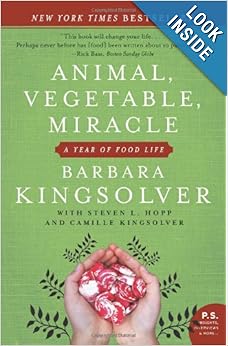
I picked up this book last year, 2013, when I had a need to "hold" a book and read. I had heard about the book from somewhere, or someone, and I can't remember where or who now, but I'm glad I went searching for the book.
I won't spoil it for you, you can go over to amazon or to your local book store and take a peak at it there.
I will say that once you've read it, you begin to think about where your food comes from. Truly. I know that farmers grow my food, but it made me more aware of "where" my food comes from and I began to look when I was shopping for my groceries.
I was surprised and appalled to see that a lot of the canned items I was using were from other countries. Why are mushrooms coming from CHINA when Pennsylvania has one of the largest mushroom growers in our country?
Why were the oranges in our orange juice coming from Brazil and other countries? I have since found a brand that juices from oranges here in the United States.
I can understand in the dead of winter there are fruits and vegetables that are not grown local and have to travel farther, but really? Why from another country?
Not just canned and fresh either, frozen as well. I probably shouldn't mention names, but Green Giant, check their labels.
When we lived in the Midwest, the potatoes and the green beans, in season, by the truck load, would roll to the Green Giant plants. Tractor trailer loads! What a sight to see. But now, look at their labels.
The book was the primary reason why I decided we had to figure out a way to grow more of our own food.
Our yard presents us with great challenges, and Dear Darling was so wonderful to build my main garden for me. It was a tremendous amount of work and expense, but it did very well for it's first year, I'm happy to say. While I did not keep any true records of how much was grown, we did have something from it nearly every week once it was producing, and it's the first time I ever canned my own tomatoes and dried them.
This book helped me to begin our journey to a simpler life and growing where I am planted.
What book got you started on your simple life or your gardening journey?
Wednesday, December 18, 2013
Compost
Yes, winter is "almost" here in the North Eastern part of the United States. It is a few days away, according to the calendar, but it has felt like winter for a few weeks now.
I'm thinking about compost. I guess, once a person begins to garden, their thoughts are never truly far away from the soil of their garden.
.JPG)
One of the books I took out of the library is "The Rodale Book of Composting" Deborah L. Martin and Grace Gershuny, Editors. The copyright of the book is 1992, so while the information in it is 21 years old, I am sure there are a few things that I can glean from the book that will help me to better understand how to "grow my soil".
Did you know, there is actually a "history" of composting? I didn't, but I'm not going to go in to that here.
I wanted to share just one topic from the book today that I found interesting and have never really given thought to. In Chapter 5, there is a section called "from trash to treasure", here is what I wanted to share:
I never really thought of this one before. Granted the book is 20 + years old, but I always thought that any food waste in my garbage can would decompose and make soil in the landfill. I'm wrong about that and I have to try to be a better steward of my resources.
I never thought that by composting my organic matter it would help, not only my garden, but would also help my community by lowering the cost to haul away my garbage.
I do know that my community does offer yard waste recycling. Those pick ups are only done during the summer and fall months of the year, the rest of the time, if you put out yard waste, they just throw it into the garbage truck.
And, it saves energy! I never thought of this one either.
Before the winter weather arrived, we began our first compost pile in our yard. I am so looking forward to using it in our garden next season. And reading just these two paragraphs in this book has got me thinking about better ways for me to use all the organic material I can from our yard to compost it to make soil and to save money and energy.
Isn't it amazing how when you start to do one thing, so many other things open up to you?
I'm thinking about compost. I guess, once a person begins to garden, their thoughts are never truly far away from the soil of their garden.
One of the books I took out of the library is "The Rodale Book of Composting" Deborah L. Martin and Grace Gershuny, Editors. The copyright of the book is 1992, so while the information in it is 21 years old, I am sure there are a few things that I can glean from the book that will help me to better understand how to "grow my soil".
Did you know, there is actually a "history" of composting? I didn't, but I'm not going to go in to that here.
I wanted to share just one topic from the book today that I found interesting and have never really given thought to. In Chapter 5, there is a section called "from trash to treasure", here is what I wanted to share:
Up to 75% of household garbage is derived from organic matter and, theoretically, can be composted. If you include sewage sludge, the rate is even higher. Even if the finished product were simply dumped into a landfill, composting would realize savings because the sheer bulk of the material would be reduced by almost half. Furthermore, it would no longer pose a toxic leachate problem, requiring expensive liners and test wells. Using the resulting compost to build healthy soil can be regarded as an added bonus.
I never really thought of this one before. Granted the book is 20 + years old, but I always thought that any food waste in my garbage can would decompose and make soil in the landfill. I'm wrong about that and I have to try to be a better steward of my resources.
I never thought that by composting my organic matter it would help, not only my garden, but would also help my community by lowering the cost to haul away my garbage.
I do know that my community does offer yard waste recycling. Those pick ups are only done during the summer and fall months of the year, the rest of the time, if you put out yard waste, they just throw it into the garbage truck.
Compost conserves energy because it supplies soil nutrients without calling on fossil fuel support. It saves energy because it can be made on the farm and in the garden, requiring no transportation from a factory. It saves energy because it is waste recycled via a very short route - so short as the distance from the kitchen to the backyard compost heap. Even the organic debris of an entire city can be recycled and returned to the land without leaving the metropolitan area. Compare this system with the one we have been following since World War II, and you begin to see not only a major root of our current solid wastes and energy problems, but a solution to those problems as well.
And, it saves energy! I never thought of this one either.
Before the winter weather arrived, we began our first compost pile in our yard. I am so looking forward to using it in our garden next season. And reading just these two paragraphs in this book has got me thinking about better ways for me to use all the organic material I can from our yard to compost it to make soil and to save money and energy.
Isn't it amazing how when you start to do one thing, so many other things open up to you?
 |
| Look for a future post about this project. |
Monday, December 16, 2013
My trip to the library
I haven't been in our town library in quite a few years. The internet usually provides me with plenty of information.
But, as I've mentioned before, I am a book person, and I don't want to buy all the books that I want to read, so I have to start to use my library again.
Anyway, we have a very small library, but, there were a number of books on gardening that I would like to read, so this time I checked out 4 books. I plan to share all of them with you over time, and some of the thoughts that I got out of them.
I also wanted to begin using my library again to support them and to save my family some money. Plus, I'm hoping that perhaps, they may have information on any garden groups or things going on in my county to help with simplifying our lives.
I would like to encourage you to pay a visit to your local library today.

But, as I've mentioned before, I am a book person, and I don't want to buy all the books that I want to read, so I have to start to use my library again.
Anyway, we have a very small library, but, there were a number of books on gardening that I would like to read, so this time I checked out 4 books. I plan to share all of them with you over time, and some of the thoughts that I got out of them.
I also wanted to begin using my library again to support them and to save my family some money. Plus, I'm hoping that perhaps, they may have information on any garden groups or things going on in my county to help with simplifying our lives.
I would like to encourage you to pay a visit to your local library today.

Saturday, December 14, 2013
Garden Wisdom

When I decided that I really wanted to make a good effort at growing a garden, I decided that I needed to know as much as I could to grow the best I could.
Now, I love the Internet, and I probably spend more time than I should on it, but to me, it's like having a library in my home and I LOVE that. Sad to say though, I haven't been to my library in years, but that's another story.
Anyway, I found a few books, that I actually did purchase and this is one of them.
"Garden Wisdom and Know How: Everything You Need to Know to Plant, Grow and Harvest"

It is from the Editors of Rodale Gardening Books, of which I get the Organic Gardening magazine. Made here in the United States.
The only thing that I don't like about the book is the print size. As you can see, the book is rather large, it contains a lot, but the print is small.
There are 10 chapters in the book and I have found a number of items in the book that have been helpful with my garden this year and I have not completed reading it.
The first chapter, Getting Started, is 74 pages long and it talks mostly about learning the zone you live in and composting. Growing your soil.
I have learned a lot from just one chapter of this book and I am reading into the next chapter now, which is "Gardening Techniques and Tricks".
Do you have a favorite, go to, gardening book?
Wednesday, December 11, 2013
I bought a new book
I try very hard to stay out of the book stores. There was a time in my life, where, if I hadn't stopped, it probably would have become a serious problem.
I grew up loving books and the places they would/could take you. And once I had one, I didn't want to give it away.
When we moved, halfway across the country, I had to purge myself of nearly all of my books. Books of learning or information were carefully weeded through and kept and books of pleasure were AGONIZED over before being let go to the Goodwill shop.
Anyway, I now will only buy a book if I really feel what I am going to get out of it is worth having in my home. Also, it has to be printed here in the United States. If I am going to spend my hard earned money, I need to be sure it is going to help someone else retain their job.
Okay, now you know some of my basic thoughts on books. Now, onto the book I bought.
"The New Seed-Starters Handbook" by Nancy Bubel
I want to start most of my plants on my own this coming season and in the past, I have had failed attempts. There must be something, well, a lot of something's, that I'm not doing correctly and this time I need a bit of instruction on to how to do it.
As far as inside plants, I don't have a green thumb at all. Outside. That's another story. So I need help with learning the proper steps for starting seed indoors to have a more successful outside garden experience.

While I haven't read much of the book yet, so I can't review it for you, I will tell you what chapters this book has in it. Actually there are four Sections and each has chapters in them.
Section One : Starting Seeds Indoors
Section Two : Moving Plants Outdoors
Section Three : Special Techniques and Situations
Section Four : Saving Seeds and Making Further Plans
I thought each one of these chapters will help me along my journey to have better seed starts and a better garden this coming spring.
I grew up loving books and the places they would/could take you. And once I had one, I didn't want to give it away.
When we moved, halfway across the country, I had to purge myself of nearly all of my books. Books of learning or information were carefully weeded through and kept and books of pleasure were AGONIZED over before being let go to the Goodwill shop.
Anyway, I now will only buy a book if I really feel what I am going to get out of it is worth having in my home. Also, it has to be printed here in the United States. If I am going to spend my hard earned money, I need to be sure it is going to help someone else retain their job.
Okay, now you know some of my basic thoughts on books. Now, onto the book I bought.
"The New Seed-Starters Handbook" by Nancy Bubel
I want to start most of my plants on my own this coming season and in the past, I have had failed attempts. There must be something, well, a lot of something's, that I'm not doing correctly and this time I need a bit of instruction on to how to do it.
As far as inside plants, I don't have a green thumb at all. Outside. That's another story. So I need help with learning the proper steps for starting seed indoors to have a more successful outside garden experience.

While I haven't read much of the book yet, so I can't review it for you, I will tell you what chapters this book has in it. Actually there are four Sections and each has chapters in them.
Section One : Starting Seeds Indoors
Section Two : Moving Plants Outdoors
Section Three : Special Techniques and Situations
Section Four : Saving Seeds and Making Further Plans
I thought each one of these chapters will help me along my journey to have better seed starts and a better garden this coming spring.
I would love to hear any of your advice on how you start your seeds for your garden.
Thursday, September 19, 2013
The book that got me interested
I wanted to share today a book I read,
"animal, vegetable, miracle - a year of food life" by Barbara Kingsolver.
Amazon link to book
I used to have an obsession with books, so when we moved, I purged a large part of my library and really have tried over the past 7 years not to accumulate as many books. We have no book shelves here, which I am truly in need of now. But I think this is one of the things that has helped me to not acquire as many books.
Anyway, I read this book in the winter and just loved it. It helped me to see how truly important it is that each one of us, in our own way, try to support nature, to care for it, so that it will care for us.
Food does travel too far to get to us.
Buying local is important. It helps the local economy. It helps the local farmer.

Does it have to be organic? No, I don't necessarily think so. The government places too many rules for small, family farmers to become organic, but if you know your farmer, they don't mind answering the questions you have about their growing practices. I have noticed that when I ask at the market if they are organic, they will say, "we grow organic but are not certified". If I really have a specific question, they answer it.
Now, do I believe everything everyone tells me. "sure it's true, it's on the Internet."
Most times I would say I like to give the benefit of the doubt that they are telling me the truth, and I observe. You can usually tell when someone is telling you a story just by their actions.
I really enjoyed reading this book and I would encourage you to take a look at it. Amazon has plenty of used copies and it is even on kindle. Which, by the way, I do own one. Thinking that I could have all the books I wanted and no one would have to know. But, I am sad to say, I've had it three years now and besides a few free books, I think I have three paid books on it. I like a book! I like the feel of the binding, the pages, the smell....... I told you it was an obsession!
Now, where was I going with all this?
This is the book that truly got me interested in having a garden to provide fresh food for our family. I wanted to see how hard it would be to grow what we like here, with our hilly back yard. It also made me try our farmers market. Which, after living here for 7 years, I kept saying I needed to go and never did. I finally went when I started wanting to make pickles this year and haven't missed a week since.
Read a book on gardening. Support your local farmer for the things you can't or don't grow. And share your knowledge with someone along the way.
.JPG)
Until next time,
Grow where you are planted!
"animal, vegetable, miracle - a year of food life" by Barbara Kingsolver.
Amazon link to book
I used to have an obsession with books, so when we moved, I purged a large part of my library and really have tried over the past 7 years not to accumulate as many books. We have no book shelves here, which I am truly in need of now. But I think this is one of the things that has helped me to not acquire as many books.
Anyway, I read this book in the winter and just loved it. It helped me to see how truly important it is that each one of us, in our own way, try to support nature, to care for it, so that it will care for us.
Food does travel too far to get to us.
Buying local is important. It helps the local economy. It helps the local farmer.

Does it have to be organic? No, I don't necessarily think so. The government places too many rules for small, family farmers to become organic, but if you know your farmer, they don't mind answering the questions you have about their growing practices. I have noticed that when I ask at the market if they are organic, they will say, "we grow organic but are not certified". If I really have a specific question, they answer it.
Now, do I believe everything everyone tells me. "sure it's true, it's on the Internet."
Most times I would say I like to give the benefit of the doubt that they are telling me the truth, and I observe. You can usually tell when someone is telling you a story just by their actions.
I really enjoyed reading this book and I would encourage you to take a look at it. Amazon has plenty of used copies and it is even on kindle. Which, by the way, I do own one. Thinking that I could have all the books I wanted and no one would have to know. But, I am sad to say, I've had it three years now and besides a few free books, I think I have three paid books on it. I like a book! I like the feel of the binding, the pages, the smell....... I told you it was an obsession!
Now, where was I going with all this?
This is the book that truly got me interested in having a garden to provide fresh food for our family. I wanted to see how hard it would be to grow what we like here, with our hilly back yard. It also made me try our farmers market. Which, after living here for 7 years, I kept saying I needed to go and never did. I finally went when I started wanting to make pickles this year and haven't missed a week since.
Read a book on gardening. Support your local farmer for the things you can't or don't grow. And share your knowledge with someone along the way.
Until next time,
Grow where you are planted!
Subscribe to:
Posts (Atom)